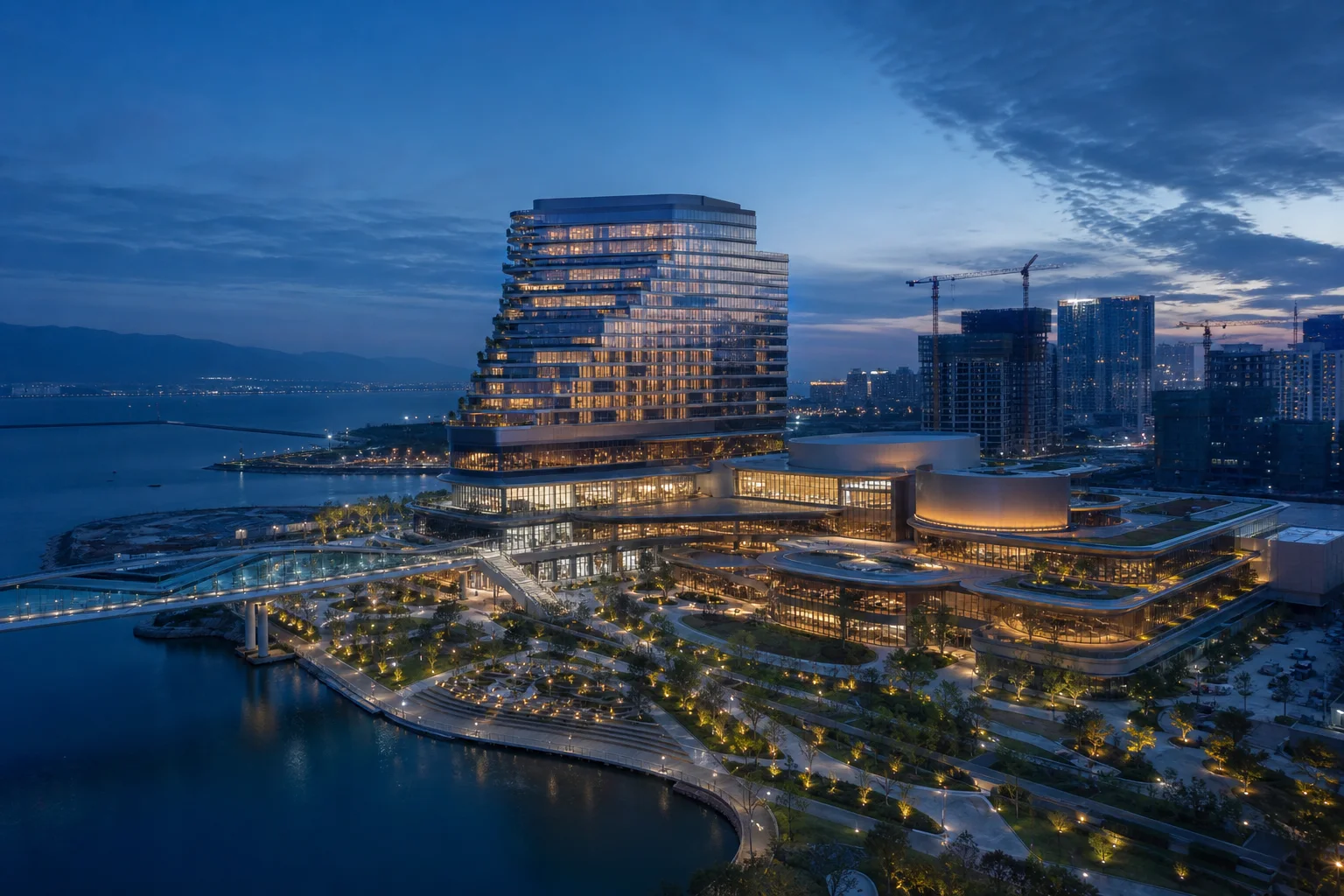
On December 15, 2025, the New York State Gaming Commission unanimously voted to license three new downstate commercial casinos: Bally’s Bronx at Ferry Point, Hard Rock Metropolitan Park at Willets Point in Queens and Resorts World New York City at Aqueduct in Queens. The decision ended a long selection contest and started three different delivery programmes.
The distinction between licence award and public opening is essential. A gaming facility still needs construction or conversion, equipment and systems approval, staff licensing, inspection and an operating certificate before casino operations begin. The executed Hard Rock licence, for example, states that its 20-year duration runs from issuance of the operation certificate, not simply from the December 2025 award.
Three sites, three development paths
Bally’s Bronx
The Ferry Point proposal is a new destination project in the Bronx. Its delivery risk centres on a complex site, major construction and the integration of resort uses with surrounding infrastructure and community commitments. The approved tax rates published by the Commission are 30% for slot-machine and electronic-table-game revenue and 10% for table games, including retail sports wagering.
Hard Rock Metropolitan Park
The Willets Point project is planned beside Citi Field in Queens and is tied to a wider entertainment and public-realm vision. Queens Future LLC holds the licence. New York lists tax rates of 25% on slot and electronic-table revenue and 10% on table games, including retail sports wagering.
Resorts World New York City
Resorts World already operates a video-lottery-terminal facility at Aqueduct. Its licence enables conversion to a full commercial casino with live table games, making its construction and operating sequence different from a greenfield site. The Commission lists a 56% tax on slot and electronic-table revenue and 30% on table games, including retail sports wagering.
| Licensed project | Location | Slot / ETG tax | Table-game tax |
|---|---|---|---|
| Bally’s Bronx | Ferry Point, Bronx | 30% | 10% |
| Hard Rock Metropolitan Park | Willets Point, Queens | 25% | 10% |
| Resorts World New York City | Aqueduct, Queens | 56% | 30% |
Rates above are those published by the New York State Gaming Commission. Product definitions and revenue distribution are governed by the applicable licence and law.
Why openings will be staggered
Project announcements often encourage a single mental image: three casinos selected, three casinos soon open. The operational reality is a sequence of site-specific critical paths. An existing facility conversion can phase around current operations. A new-build district must complete enabling works, foundations, vertical construction, fit-out and extensive commissioning.
Environmental commitments and local approvals do not disappear after selection. Applicants were required to complete entitlement processes, including environmental review under the State Environmental Quality Review Act, before the selection deadline. Mitigation, design commitments and public reporting can carry into delivery.
Status vocabulary
Licensed means the Commission has awarded a gaming-facility licence. Operational requires the further certificate issued when a facility is ready and compliant. Nova Rindale will not use the terms interchangeably.
The capital and public-benefit test
The siting process gave economic activity and business development a 70% weighting, with local impact, workforce enhancement and diversity each receiving 10%. A minimum capital investment and licence fee of US$500 million formed the baseline. Applications competed above that floor with their own scope, tax and benefit commitments.
Those commitments now become monitoring questions. Construction employment is temporary; operating employment is durable but depends on the delivered mix of gaming, hotel, food, entertainment and maintenance. Transit effects, local purchasing, surrounding business impact and tax distribution require observed data after opening, not only application-stage modelling.
Tax rates also shape the properties differently. A higher statutory or proposed share does not automatically produce the greatest public revenue because the tax base depends on actual gaming revenue. Nor does gaming tax capture every fiscal effect: licence payments, sales and hotel taxes, payroll, infrastructure costs and displaced activity all matter.
What to watch through 2026 and beyond
- Operating-certificate milestones: the regulator’s clearest line between project and live facility.
- Construction sequencing: whether hotels, entertainment venues and public spaces open with or after gaming.
- Capital revisions: any material change to scope, financing or project phasing.
- Workforce delivery: hiring, licensing, training and labour commitments.
- Vendor approvals: the equipment and systems pipeline for three large installations.
- Public reporting: how state and local bodies measure traffic, tax, employment and community effects.
The licence decision closed the race. It did not close the public-interest file.
For the North American casino supply chain, three downstate properties represent a major multi-year opportunity. For New York, they are a governance test: whether competitive commitments can be translated into built infrastructure, compliant operations and transparent public outcomes.
Primary sources
- New York State Gaming Commission — commercial casinos, approved licences and tax rates.
- New York Gaming Facility Location Board — selections and final findings.
- Evaluation criteria and statutory process.
- December 15, 2025 Commission meeting archive.
Project schedules and scope are forward-looking and may change. Source review completed August 17, 2026.